

Ecomask Spray
Our recommended nematode for fleas, and a hardy choice for hot, dry climates.
From $37.99
Chrysoteuchia topiarius
A sod webworm moth whose caterpillars chew roots and stems of cranberry, conifer seedlings, and turf.
Adults are small, whitish-tan moths with a snout-like front and a gold band on the wing. Larvae are dirty white caterpillars with a brown head, up to 3/4 inch long.
Larvae chew through the bark of runners and roots near the soil, girdling them. Plants turn brown in late summer or the next spring. In turf it causes brown patches like other sod webworms.
The caterpillars live in the soil and thatch (the layer of dead stems on top of the soil), where nematodes can reach them. They spend the winter there in silk cocoons, then turn into pupae in the soil.
Cornell University rates Steinernema carpocapsae (the nematode in Ecomask) at 70% control or better in field tests. Field studies in the Pacific Northwest ranged from 44 to 92% control. Heterorhabditis bacteriophora (the nematode in Heteromask) has also been tested.
In university research, the timing that worked best was late summer to early fall (August to October), when the young caterpillars are feeding.
Treat with Ecomask.
When: May to October.
Where: Spray the soil and thatch over the affected area, then water it in.
See How to apply for step-by-step directions, or use the calculator on the Ecomask Spray page to see how much you need.
Our recommended nematode for fleas, and a hardy choice for hot, dry climates.
From $37.99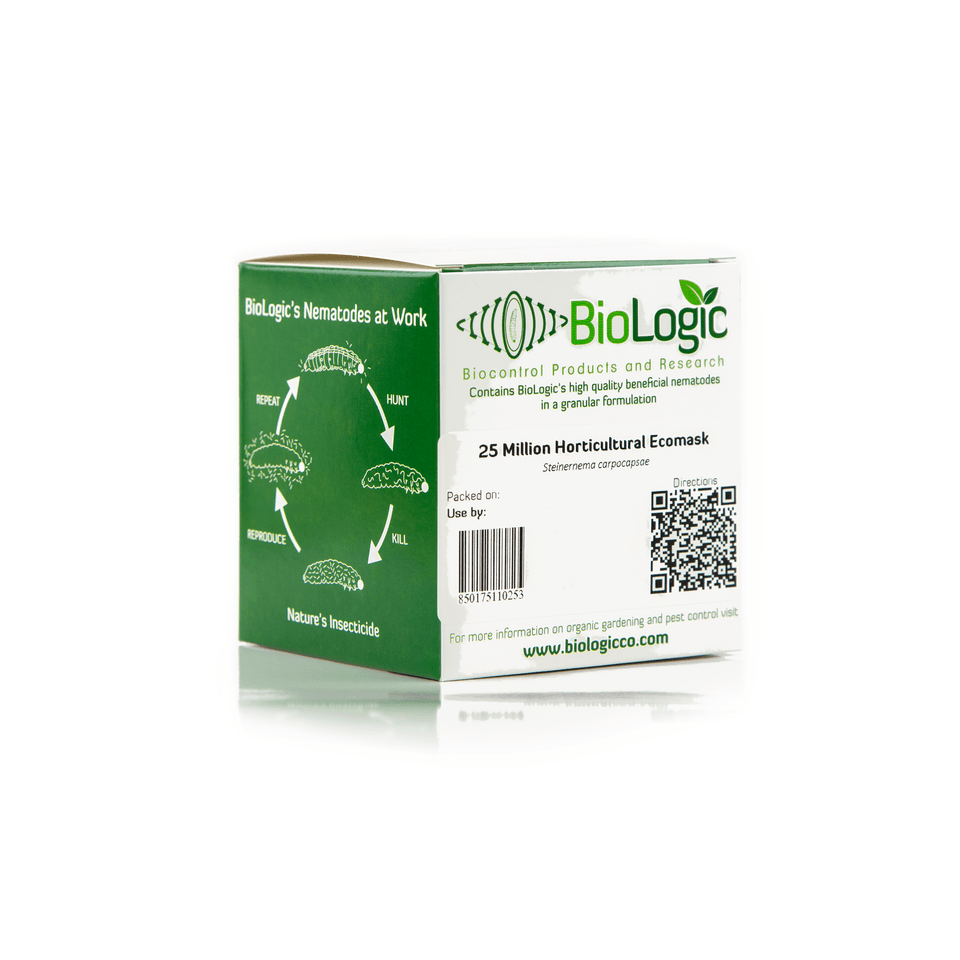
Ecomask, our flea nematode, in a granular form you mix with peat moss or potting soil and spread by hand.
$59.99